Mussoorie, 19 Dec: Copies of writer and Barrister John Lang’s newspaper, ‘Mofussilite’, and related documents are among the prized possessions of the National Archives of Pakistan (NAP). NAP has a large collection of newspapers and periodicals, but the oldest file is of ‘The Mofussilite’.
It may be recalled that ‘The Mofussilite’ made a humble beginning on 2 August 1845 in Calcutta. In 1846, Lang decided to publish it from Ambala and, later, it was shifted to Meerut and Agra. On 1 March 1859, it again moved from Agra to Meerut.
The Pakistan Archives have the rare 1848 file of The Mofussilite. The NAP is a member of the International Council on Archives and its regional branch is called the South and West Asian Regional Branch of the International Council of Archives (SWARBICA).
The copies of The Mofussilite are available in two places in India - at the National Library (Kolkata) and Nehru Museum & Library (New Delhi). Even the British Library (London) has microfilms of the newspaper’s issues from 2 August to 22 November 1845, and from 1 January, 1847 to 24 May, 1876.
The Pakistan Archives Collection consists of 1530 titles. The oldest file is of The Mofussilite (Agra). The Civil and Military Gazette (1873-1963) is the biggest newspaper file.
The project of microfilming Indian newspapers began in collaboration with the Center for Research Libraries, University of Chicago. Under the project, the microfilming of The Mofussilite was done at the Nehru Memorial Library & Museum (New Delhi). The Nehru Museum has issues of the years 1845, 1858 to 1876 as digital copies of John Lang’s newspaper. The 1846 issues of The Mofussilite are not available in any collection worldwide.
Besides editing and printing The Mofussilite, Lang was involved in writing. John Lang wrote over twenty novels and most of them were published anonymously in India as serials in his newspaper. At least five of his novels were never published as books, but appeared only as serials. The Australian based Mulini Press is in the process of publishing these unknown novels. Some of his works have an Australian setting and others are set in India and England. He also wrote stories and articles on the Indian people with others set in England.
Thursday, April 29, 2010

Tuesday, January 09, 2007
John Lang’s newspaper now being published from Australia

Raju Gusain
Mussoorie, 8 Jan: The Mofussilite newspaper has received a new lease of life. This newspaper, which was launched and edited by John Lang, who died here on 20 August 1864, is now being printed from Australia. It is now no longer a bi-weekly as it was in 1859.
The New Mofussilite is a bi-annual journal published by an Australian publishing house under the John Lang Project. Disclosing this, Victor Crittenden says, “The New Mofussilite is a small publication sent to Associate Members of the John Lang Project to keep them informed on progress. It will be issued twice a year and is published by the Mulini Press (Canberra).” Crittenden is author of ‘John Lang: Australia’s Larrikin Writer’.
It will be recalled that Mofussilite made a humble beginning on 2 August 1845 in Calcutta. In 1846, Lang decided to publish it from Ambala and later it was shifted to Meerut and Agra. On 1 March 1859, Mofussilite again moved from Agra to Meerut.
Regarded as the first Australian born novelist, John Lang was among those rare white men who provided support to Indians during the 'First War of independence'. He fought the famous case of Rani Laxmi Bai against the annexation of the province of Jhansi in 1854. John Lang is buried at the Camel's Back graveyard here.
The inaugural issue of the New Mofussilite was printed last year. It contains news snippets on Lang worldwide. Reports and articles on this unsung Aussie writer make the journal an informative publication.
In December 2006, the second issue of the New Mofussilite was published and it includes an extrapolation on John Lang’s first love. The journal aims at informing readers about the latest research on the first Australian novelist.
Earlier, local people believed that Lang also published his newspaper from here. But author Victor Crittenden presents a totally different opinion. He says, “Lang was involved in creative work in Mussoorie during his stay. But he never established his press in the hill station. He was looked after by his Indian servants. He could send down copy for the newspaper to be printed in Meerut and occasionally make a short visit to check things, essentially leaving the business to his printer Gibbons, who continued to act as an assistant editor."
The New Mofussilite should be looked upon as a move to preserve and promote the life and works of John Lang.
Garhwal Post
9 January, 2007
Dehradun
Mussoorie, 8 Jan: The Mofussilite newspaper has received a new lease of life. This newspaper, which was launched and edited by John Lang, who died here on 20 August 1864, is now being printed from Australia. It is now no longer a bi-weekly as it was in 1859.
The New Mofussilite is a bi-annual journal published by an Australian publishing house under the John Lang Project. Disclosing this, Victor Crittenden says, “The New Mofussilite is a small publication sent to Associate Members of the John Lang Project to keep them informed on progress. It will be issued twice a year and is published by the Mulini Press (Canberra).” Crittenden is author of ‘John Lang: Australia’s Larrikin Writer’.
It will be recalled that Mofussilite made a humble beginning on 2 August 1845 in Calcutta. In 1846, Lang decided to publish it from Ambala and later it was shifted to Meerut and Agra. On 1 March 1859, Mofussilite again moved from Agra to Meerut.
Regarded as the first Australian born novelist, John Lang was among those rare white men who provided support to Indians during the 'First War of independence'. He fought the famous case of Rani Laxmi Bai against the annexation of the province of Jhansi in 1854. John Lang is buried at the Camel's Back graveyard here.
The inaugural issue of the New Mofussilite was printed last year. It contains news snippets on Lang worldwide. Reports and articles on this unsung Aussie writer make the journal an informative publication.
In December 2006, the second issue of the New Mofussilite was published and it includes an extrapolation on John Lang’s first love. The journal aims at informing readers about the latest research on the first Australian novelist.
Earlier, local people believed that Lang also published his newspaper from here. But author Victor Crittenden presents a totally different opinion. He says, “Lang was involved in creative work in Mussoorie during his stay. But he never established his press in the hill station. He was looked after by his Indian servants. He could send down copy for the newspaper to be printed in Meerut and occasionally make a short visit to check things, essentially leaving the business to his printer Gibbons, who continued to act as an assistant editor."
The New Mofussilite should be looked upon as a move to preserve and promote the life and works of John Lang.
Garhwal Post
9 January, 2007
Dehradun
Saturday, October 21, 2006
Australia’s long-lost writer remembered in India
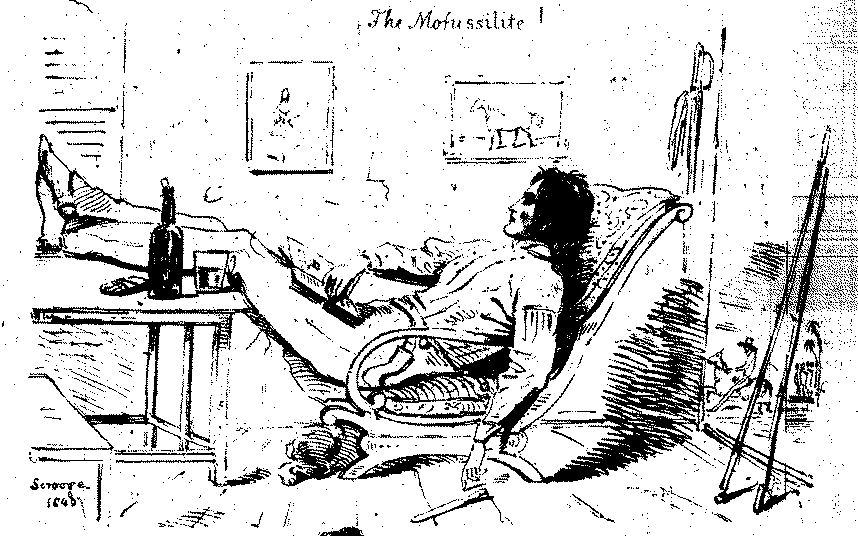 Rake sketch of John Lang (The Mulini Press)
 Australia-India Focus,
July-Sept 2 0 0 5
A long-neglected cultural link between Australia and India is being revived, with the unveiling of a memorial plaque to the first Australian-born novelist, John Lang, in the Indian town where he is buried. Born in Parramatta in 1816, Lang moved to India at 25, and spent most of the rest of his life there. He died in 1864 in the Himalayan hill station of Mussoorie, where a hundred years later his grave was discovered by local resident and celebrated author Ruskin Bond.
As a barrister, journalist, writer, scholar and inveterate traveller, Lang was a friend of India. He was a gifted student of Indian languages. His travel writings about India for Charles Dickens’ journal Household Words are among the most vivid accounts of the India of his day. Lang founded a popular newspaper, The Mofussilite, which often took a critical line against the East India Company. He also represented some prominent Indians, including the Rani of Jhansi, in their legalfights against the British — which did not earn him friends in the establishment. He was even imprisoned after being convicted of defaming a Company officer in his newspaper.In Australia, meanwhile, John Lang is known more for his works of fiction set in the early decades of the colony, including the novel The Forger’s Wife and the collection of short stories Botany Bay.
As a barrister, journalist, writer, scholar and inveterate traveller, Lang was a friend of India. He was a gifted student of Indian languages. His travel writings about India for Charles Dickens’ journal Household Words are among the most vivid accounts of the India of his day. Lang founded a popular newspaper, The Mofussilite, which often took a critical line against the East India Company. He also represented some prominent Indians, including the Rani of Jhansi, in their legalfights against the British — which did not earn him friends in the establishment. He was even imprisoned after being convicted of defaming a Company officer in his newspaper.In Australia, meanwhile, John Lang is known more for his works of fiction set in the early decades of the colony, including the novel The Forger’s Wife and the collection of short stories Botany Bay.
The new Lang plaque is in Mussoorie’s Christ Church, the oldest church in the Himalayas. This church was where Lang’s second marriage took place in 1861. Three years later, Lang’s funeral rites were performed by the Christ Church Chaplain.The plaque was commissioned by two Australian Lang scholars, Rory Medcalf — who began his study of the subject during a diplomatic posting to India — and Victor Crittenden, who has been researching Lang for many years. The Mussoorie plaque is not the only recent boost to Lang’s profile. In September, Victor Crittenden’s long-awaited biography of Lang, John Lang: Australia's Larrikin Writer was launched in Canberra by the Director-General of the Australian National Library, Jan Fullerton AO. This is the first comprehensive account of Lang’s life in Australia, England and India, and reflects a wealth of in-depth literary detective work onLang’s novels and journalism.
Through his Mulini Press, Mr Crittenden has also commenced a ‘John Lang Project’. This includes developing a dedicated website as well as plans to republish many of John Lang’s works in the years ahead. In 2006, the Project is due to publish a collection of Lang’s Indian stories edited by Mr Crittenden and Mr Medcalf.
The Indian press is also beginning to take an interest in John Lang. A journalist in Dehra Dun, Raju Gusain, is helping to generate publicity about the subject, while another, Jai Prakash Uttarakhandi, has even named his weekly English/Hindi newspaper the Mafasilite in honour ofLang’s journal. Rick Hosking of the Department of English at Flinders’ University, who has a long-standing interest in Lang’s and other English-language literature of India, has welcomed the revival of interest in Lang, and the momentum that this reflected for ‘generating cultural connections between Australia and India’.
(The Australia-India Focus newsletter is produced bi-monthly by the Australia-India Council www.dfat.gov.au/aic/australia_india_focus_newsletter_jul_sep2005.pdf)
Tuesday, October 03, 2006
Mofussilite was never printed from Mussoorie
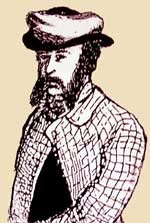
Photo: John Lang (Courtesy: Mulini Press)
Raju Gusain
Mussoorie, January 10
'Go boldly forth Mofussilite
My glory and my great delight.'
The inaugural issue of the Mofussilite newspaper began with this verse by the editor and publisher John Lang. Local people believe that John Lang also published his newspaper here. But, a new biography on Australia's first novelist John Lang that was released recently in Australia has unpleasant news for people of Mussoorie. 'John Lang: Australia's larrikin writer by Victor Crittenden clearly states that Mofussilite was never published from Mussoorie.
The biography published by The Mulini Press (Canberra) is an extensively researched work by Victor Crittenden. It claims that Mofussilite made a humble beginning on 2 August 1845 in Calcutta. In 1846 Lang decided to publish it from Ambala and later it was shifted to Meerut and Agra. On 1 March 1859 Mofussilite again moved from Agra to Meerut. 'John Lang: Australia's larrikin writer has extensively quoted from the Mofussilite. Incidentally, John Lang is buried at the Camel's Back graveyard in the hill station.
Lang was involved in creative work here during his stay. But he never established his press here. On this the biography writes, "Here (Mussoorie), looked after by his Indian servants, he (Lang) could settle down and write. He could send down copy for newspaper to be printed in Meerut and occasionally make a short visit to check things, essentially leaving the business to his printer Mr Gibbons who continued to act as an assistant editor."
On moving the newspaper from Calcutta to Ambala the book hints one possible reasons, "The Mofussilite means 'up country man' and it possibly indicates that he intended to move the newspaper eventually 'up country' to the less enervating climate of upper central India.' John Lang found taking out a newspaper in India not an easy job. Commenting on this he wrote in article published in 'Household Words' (UK) that it was easier to do so in England. All one had to do there was to sign a contract with a printer, advertise in newspapers and journals, employ staff who were readily available, and go to work. It was different if you wished to establish a newspaper outside the main cities in India.
Garhwal Post
January12-18, 2006
Dehradun
Uttaranchal (INDIA)
John Lang missed chance to cover 1857 Sepoy Mutiny
By RAJU GUSAIN
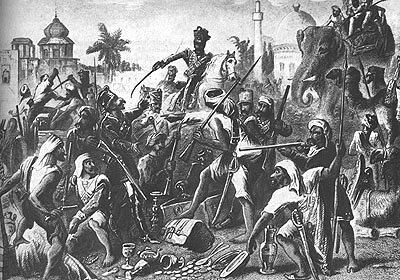
DEHRADUN:Australia's first novelist John Lang missed the golden opportunity to cover the start of the 'First War of Indian Independence' in 1857.During this period, the author, barrister and journalist was in England. Incidentally, Lang fought the famous case of Rani Laxmi Bai against the annexation of Jhansi, thus contributing to the Indian struggle for freedom.
On 10 May, 1857, Meerut saw an uprising that swept like wildfire through Northern India. Incidentally, at that period John Lang's newspaper 'The Mofussilite' was being published from Agra, not Meerut, owing to distribution problems.
Victor Crittenden, author of 'John Lang - Australia's larrikin writer', says, "John Lang left for England and the newspaper was being edited by another person in 1857. But, John Lang retained ownership of the paper. He returned to India in 1859."
It will be recalled that Lang and the East India Company developed serious differences after his successful legal defence of 'Jottee Persuad' in 1853. The barrister even served a jail term in Calcutta for fighting this famous case.
"Lang would not have been published at all in Britain's publications if he had not taken the Indian side. His article on Nana Sahib, published in Dickens'Household Words and republished in Lang's own book 'Wanderings in India', clearly indicates his personal attitude. The British Government regarded Nana Sahib as one of the great villains of the'Mutiny'. John Lang wrote about him in a totally different vein."
The Mofussilite was started on 2 August 1845 in Calcutta. In 1846, the publication was shifted to Ambala. From Ambala it moved to Meerut. Before 1857, The Mofussilite was being published from Agra. On 1 March, 1859 the newspaper moved again, this time from Agra back toMeerut.
The Mofussilite provided coverage of the 'Sepoy Mutiny' from Agra. It was possibly the only local English newspaper to do so. But it is sad that the copies of the 1857 copies of The Mofussilite are missing even from the microfilms of the British Library. The copies are also unavailable at the Jawaharlal Nehru Memorial Museum and Library (New Delhi). But many reports got published in 1857 worldwide. All quoted facts and figures from The Mofussilite.
Garhwal Post
14 May 2006
Dehradun Uttaranchal (India)
Monday, October 02, 2006
Australian envoy unveils hero's plaque in Mussoorie
Raju Gusain
Mussoorie, August 16
John Fisher, acting High Commissioner of Australia, unveiled a plaque in the memory of writer and Barrister John Lang at the Christ Church here on Monday. Lang is considered the first Australian born novelist. He came to India in 1942 and died under mysterious circumstances in this hill station on 20 August 1864.
It was a noble gesture from the Australian Government to remember unsung novelist John Lang on India's Independence Day.
Addressing the gathering John Fisher termed Lang a connection between India and Australia. "John Lang provided help to India during the independence period. He was a friend of India"
Expressing grief over the withering grave of Barrister John, Virgil D Miedema said, "Old English Cemetery should be declared a heritage site. Organizations should come forward to renovate the grave of John Lang."
In 1954 Lang became a toast of Indians by fighting the famous case of Rani Laxmi Bai against the annexation of the province of Jhansi. John George Lang was born on 19 December 1816 at Parramatta in Australia. After completing his legal studies at the Middle Temple in England (1841) he returned to Australia to be admitted as a barrister at the Sydney Supreme Court. In 1842, Lang left for India. He practiced law and did journalism in India. Lang published at least eleven novels, one/two volumes of short stories, two plays and a travel book 'Wanderings in India'. He launched a newspaper, 'The Mofussilite' from Meerut.
Hindustan Times
17 August 2005
New Delhi Edition (Late City)
Raju Gusain
Mussoorie, August 16
John Fisher, acting High Commissioner of Australia, unveiled a plaque in the memory of writer and Barrister John Lang at the Christ Church here on Monday. Lang is considered the first Australian born novelist. He came to India in 1942 and died under mysterious circumstances in this hill station on 20 August 1864.
It was a noble gesture from the Australian Government to remember unsung novelist John Lang on India's Independence Day.
Addressing the gathering John Fisher termed Lang a connection between India and Australia. "John Lang provided help to India during the independence period. He was a friend of India"
Expressing grief over the withering grave of Barrister John, Virgil D Miedema said, "Old English Cemetery should be declared a heritage site. Organizations should come forward to renovate the grave of John Lang."
In 1954 Lang became a toast of Indians by fighting the famous case of Rani Laxmi Bai against the annexation of the province of Jhansi. John George Lang was born on 19 December 1816 at Parramatta in Australia. After completing his legal studies at the Middle Temple in England (1841) he returned to Australia to be admitted as a barrister at the Sydney Supreme Court. In 1842, Lang left for India. He practiced law and did journalism in India. Lang published at least eleven novels, one/two volumes of short stories, two plays and a travel book 'Wanderings in India'. He launched a newspaper, 'The Mofussilite' from Meerut.
Hindustan Times
17 August 2005
New Delhi Edition (Late City)
Australian press to publish complete work of John Lang
Raju Gusain
Mussoorie: The Mulini Press, based in Australia, has come up with a noble idea to pay tribute to John Lang, the first Australian born novelist who died in Mussoorie. This publishing house will republish all the novels and work on John Lang by 2016. As a part of the project a website dedicated to john Lang, www.JohnLang.net, was launched recently. It will provide latest information on the literary project.
One or two books will be reprinted annually. Next year The Mulini Press plans to publish Lang's first novel Violet the Danseuse (1836). It also plans to produce Indian stories penned by John Lang separately. The planned titles are: Legends of India and Sketches of Life in Hindustan.The press is collecting copies of all letters by and to John Lang and reviews/ criticisms on John Lang's works. It also aims at encouraging research on life and work on the Australian novelist and to establish Lang memorials.
The Mulini Press series begins by taking out a compilation of short stories published in Household Words and other periodicals. The included stories in this title are those that did not featured in Lang's two books, Botany Bay and Wanderings in India. It will be recalled that John Lang wrote over twenty novels. Most of his work were serialised in his newspaper, 'The Mofussilite'. It is said that five of his novels had appeared in serials in the newspaper. The Mulini Press is in the process of publishing these unknown novels.Lang's writing minutely captures the life of Australian, India and England.
The coming week is special for lovers of John Lang as a biography of this unsung Australian novelist is all set to release. Written by Victor Crittenden and published by Mulini Press the title would release on 15 September 2005 at the National Library.Lang is best known in the literary field for his novel The Forger's Wife and short story collection Botany Bay or True Tales of Early Australia. It will be recalled that John Lang mastered the Hindi and Persian languages during his stay in India. While fighting the case of the Queen of Jhansi, he was able to argue in court and to converse with Rani Laxmi Bai without an interpreter. He also used this talent for his newspaper by translating some 'serious' poetry from Urdu to English. The press would also print these translated poetries in a book form in coming times.The Mulini Press should be lauded for the effort to preserve and also promote literary of an unsung writer.
Garhwal Post
September 2005
Dehradun
Uttaranchal (INDIA)
Mussoorie: The Mulini Press, based in Australia, has come up with a noble idea to pay tribute to John Lang, the first Australian born novelist who died in Mussoorie. This publishing house will republish all the novels and work on John Lang by 2016. As a part of the project a website dedicated to john Lang, www.JohnLang.net, was launched recently. It will provide latest information on the literary project.
One or two books will be reprinted annually. Next year The Mulini Press plans to publish Lang's first novel Violet the Danseuse (1836). It also plans to produce Indian stories penned by John Lang separately. The planned titles are: Legends of India and Sketches of Life in Hindustan.The press is collecting copies of all letters by and to John Lang and reviews/ criticisms on John Lang's works. It also aims at encouraging research on life and work on the Australian novelist and to establish Lang memorials.
The Mulini Press series begins by taking out a compilation of short stories published in Household Words and other periodicals. The included stories in this title are those that did not featured in Lang's two books, Botany Bay and Wanderings in India. It will be recalled that John Lang wrote over twenty novels. Most of his work were serialised in his newspaper, 'The Mofussilite'. It is said that five of his novels had appeared in serials in the newspaper. The Mulini Press is in the process of publishing these unknown novels.Lang's writing minutely captures the life of Australian, India and England.
The coming week is special for lovers of John Lang as a biography of this unsung Australian novelist is all set to release. Written by Victor Crittenden and published by Mulini Press the title would release on 15 September 2005 at the National Library.Lang is best known in the literary field for his novel The Forger's Wife and short story collection Botany Bay or True Tales of Early Australia. It will be recalled that John Lang mastered the Hindi and Persian languages during his stay in India. While fighting the case of the Queen of Jhansi, he was able to argue in court and to converse with Rani Laxmi Bai without an interpreter. He also used this talent for his newspaper by translating some 'serious' poetry from Urdu to English. The press would also print these translated poetries in a book form in coming times.The Mulini Press should be lauded for the effort to preserve and also promote literary of an unsung writer.
Garhwal Post
September 2005
Dehradun
Uttaranchal (INDIA)
Subscribe to:
Posts (Atom)